As a kid growing up in Skegness I was always building dens; if on the dunes hinterland it was in Sea Buckthorn and Hawthorn (now that's hardcore) but equally there was a wooded walk behind where I lived and any den there was made in cow parsley...Well I was told it was cow parsley, called it Cow Parsley and I don't recall any nasty blisters or any odd smell, so was it?


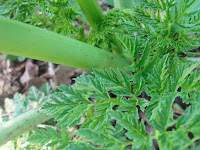


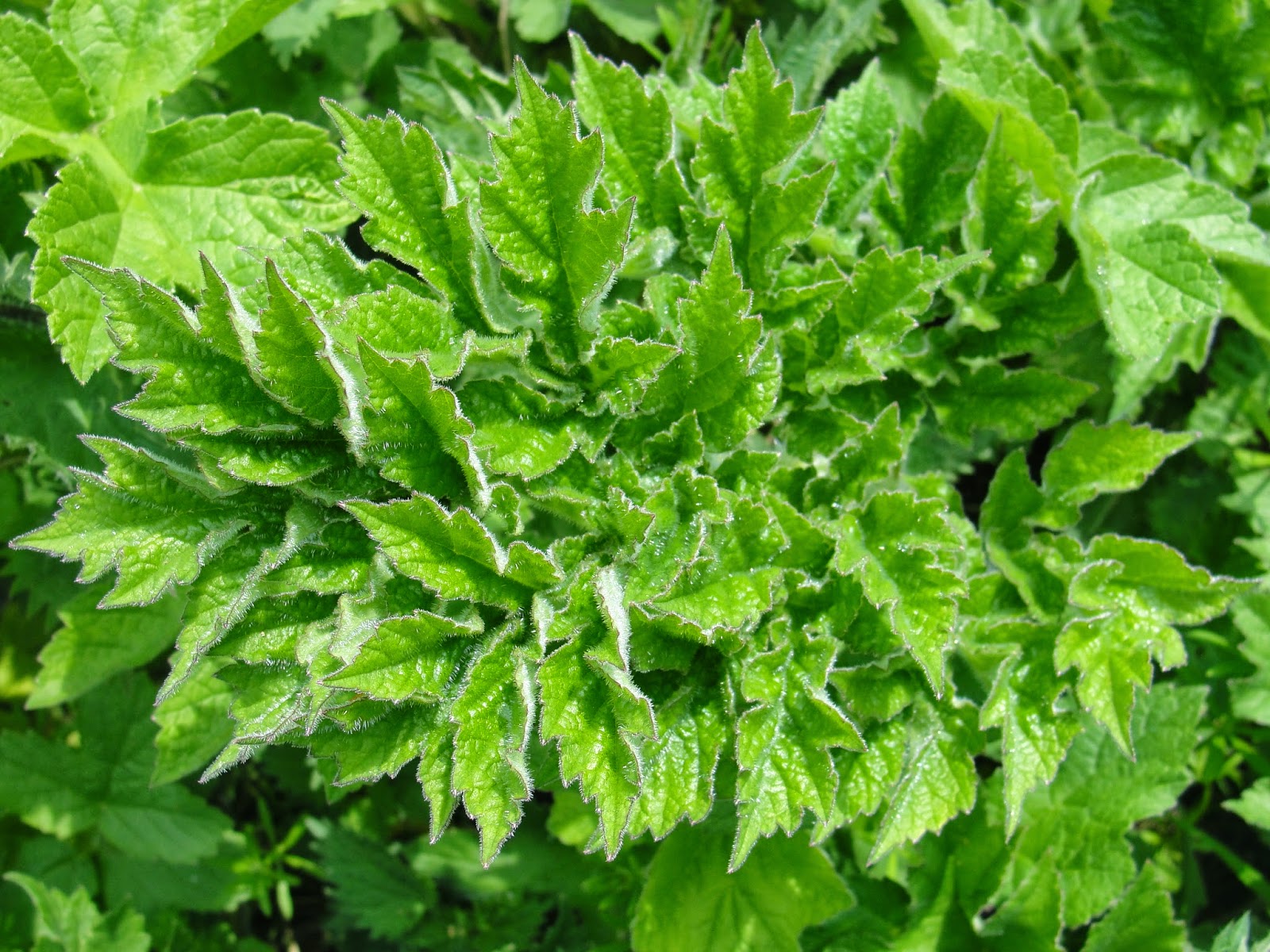


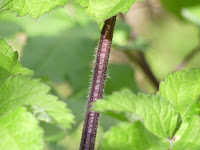

The hairy stalks are rather grooved too, again with some purple like colouration but not blotchy.


The size is impressive but the flowers and leaves are equally so and quite distinctive.




Fast forward to 'not so long ago' and the above answer on a pictorial quiz that John Rhyder posted on Facebook. Two things stand out to me; whilst I was sure of my id I still finished my answer with a question mark, and that three hours had passed and no one had posted an answer.
As I type this I am moving ever closer to a test of my id skills, During the Spring I have arranged to meet up with Forage London and as we look at edibles I have specifically asked for a location that will test my umbellifer skills, Joe O' Leary on a forage day and a day with Coastal Survival foraging by the sea, coupled with this masterclass I have joined I hope to hone this information.
So the identification of the umbellifer (Apiaceae) family...Along with the bowdrill, possibly one of the bushcrafting holy grails? all subjective but maybe. I have tried to get a handle on the local species (and beyond) and decided that I'd get my thoughts and pictures down before either source covers this family with me. There are probably other identifying features that I may not know which isn't a good start considering the plants involved so suffice to say: This is not a definitive id blog page...Don't take my word for it!
So the identification of the umbellifer (Apiaceae) family...Along with the bowdrill, possibly one of the bushcrafting holy grails? all subjective but maybe. I have tried to get a handle on the local species (and beyond) and decided that I'd get my thoughts and pictures down before either source covers this family with me. There are probably other identifying features that I may not know which isn't a good start considering the plants involved so suffice to say: This is not a definitive id blog page...Don't take my word for it!
Alexanders


I'll start off on a positive note with one I'm certain of to the extent that I've harvested it and made a rather fine soup. A Roman introduction, Alexanders are often found at coastal locations and as we had a Roman settlement near the river in my hometown I guess that accounts for them growing near me. It was superceded by celery as an edible which it bears a similar flavour to but only if the skin is scraped off the, green, smoothish hollow stalks, which is a skill because the stalks collapse easily and the skin is sticky when scraped. Leaving the skin on gives it a similar, but stronger taste to celery leaves.
It has a slightly yellow flower head (which you can just see peeking through in the top picture) and is perhaps a little more compact when compared to similar sized umbellifers. To me the slightly toothed leaf isn't lacy either and is probably the most similar to angelica. It bears hard black seeds (maybe 3-4mm?) in Autumn.
The following pictures were taken in Galloway in Scotland, I haven't found this locally but the search goes on.



It has a slightly yellow flower head (which you can just see peeking through in the top picture) and is perhaps a little more compact when compared to similar sized umbellifers. To me the slightly toothed leaf isn't lacy either and is probably the most similar to angelica. It bears hard black seeds (maybe 3-4mm?) in Autumn.
Angelica
The following pictures were taken in Galloway in Scotland, I haven't found this locally but the search goes on.

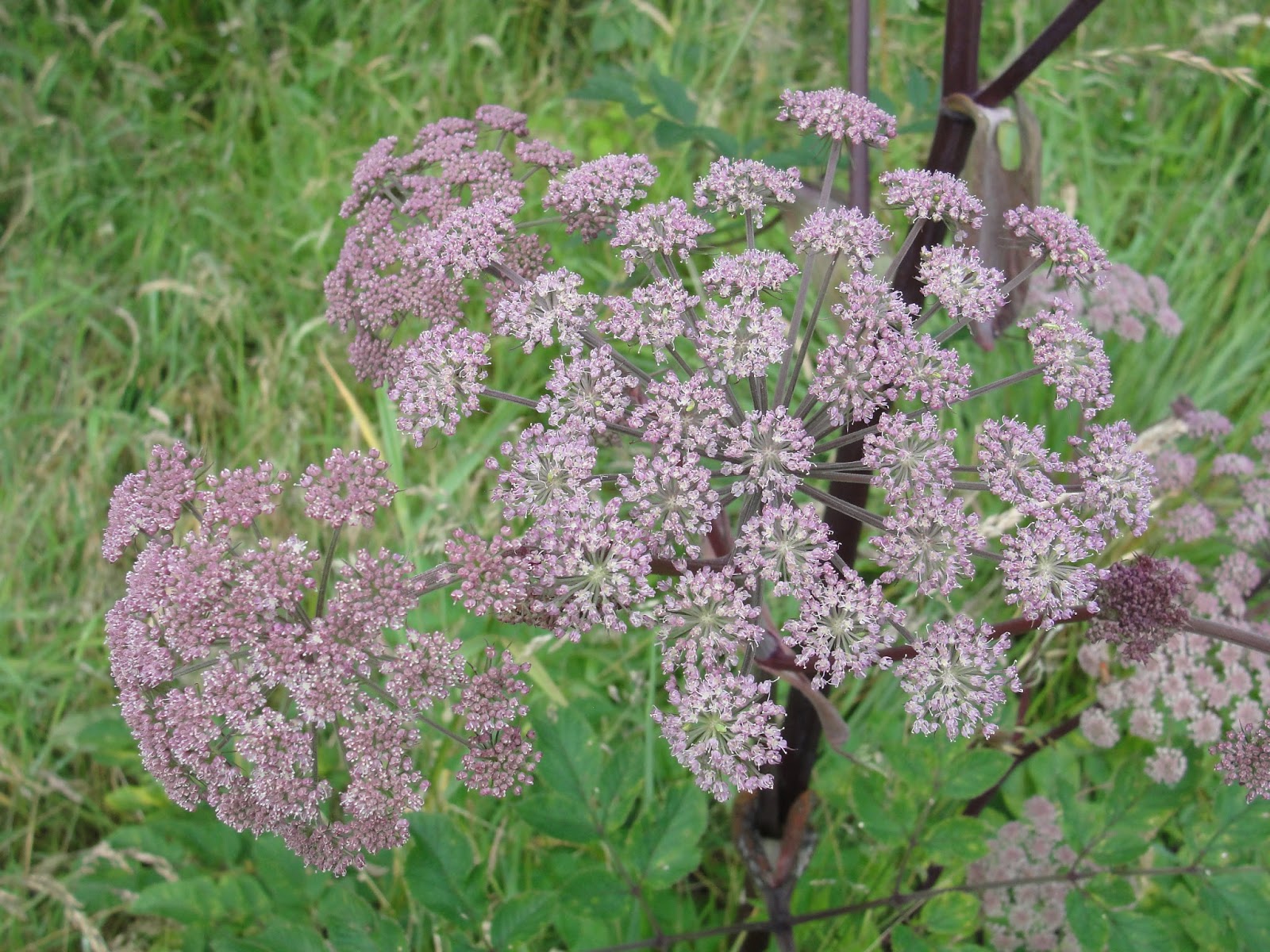
It was a fine day when I chanced upon them and it was noticeable that several flower heads had an abundance of winged insects on them. It was also striking how different the flower colour could be between white and a purplish hue.


The plants I saw were, from memory, about three feet tall and again varied in colour. the darker colouration was solid, as opposed to blotchy.


The finely toothed leaf has more than a passing resemblance to that of elder and Angelica is probably best known as a sugary cake decoration.

The stems are hollow and the smaller lengths have this curious d shaped internal 'hole' and two channels on the outside.
Wild carrot


I don't think I've got a shot of the leaf of the wild carrot but the flower is unmistakable with Nigella like bracts extending around the edge. It is also called Queen Anne's Lace and if you look at the flower head in the centre of the lower picture you can see a reddish mark, this is supposed to resemble lace that Queen Anne spilt blood on after pricking her finger. The flower head curls up into a bird nest type shape later in the season.
The root does indeed taste of carrot but in my experience they are a bit tough, and it isn't orange, or purple for that matter. It grows to somewhere between one and two feet in height.
Cow Parsley
So was this the plant that I played in as a kid? I guess the next visit to Skegness will have to include a short walk to where I built those dens 'a few years ago'...OK, last century.


I'll start off with a shot of a broken main stem. It has a modest internal diameter in comparison to that of hemlock which is featured later. Interestingly these two stems were side-by-side and yet there is a clear difference in colour.


Kevan Palmer hosting a foraging talk/ meal in St. Albans. Cow Parsley was amongst the plants talked about.
It grows in sizable patches around me and it seems different to Hemlock in the following ways: The Hemlock leaf seems to be a darker green, floppier and definitely more lacy in structure. there isn't any noticeable smell, there can be varying amount of purple on the stalks but it looks more like a wet in wet watercolour wash than dark blotches and the stems have a noticeable groove to them.
Both have hollow stems but the hollow part of a Cow Parsley stalk is smaller in comparison to Hemlock (as detailed earlier).

This is a shot of cow parsley in the early stages of flowering, the individual flowers all seem to have one petal larger than the other four and face out from the individual 'pom pom'. In general the flowers look delicate and the plant looks quite dainty compared to some of it's lookalikes and sometimes the stem appears (to me at least) to zig zag slightly between leaf shoots.
Hemlock

This is a shot of the flower heads, taken by a roadside with the right hand side one more developed than the left. Like Cow Parsley each individual flower has a slightly larger petal on each.
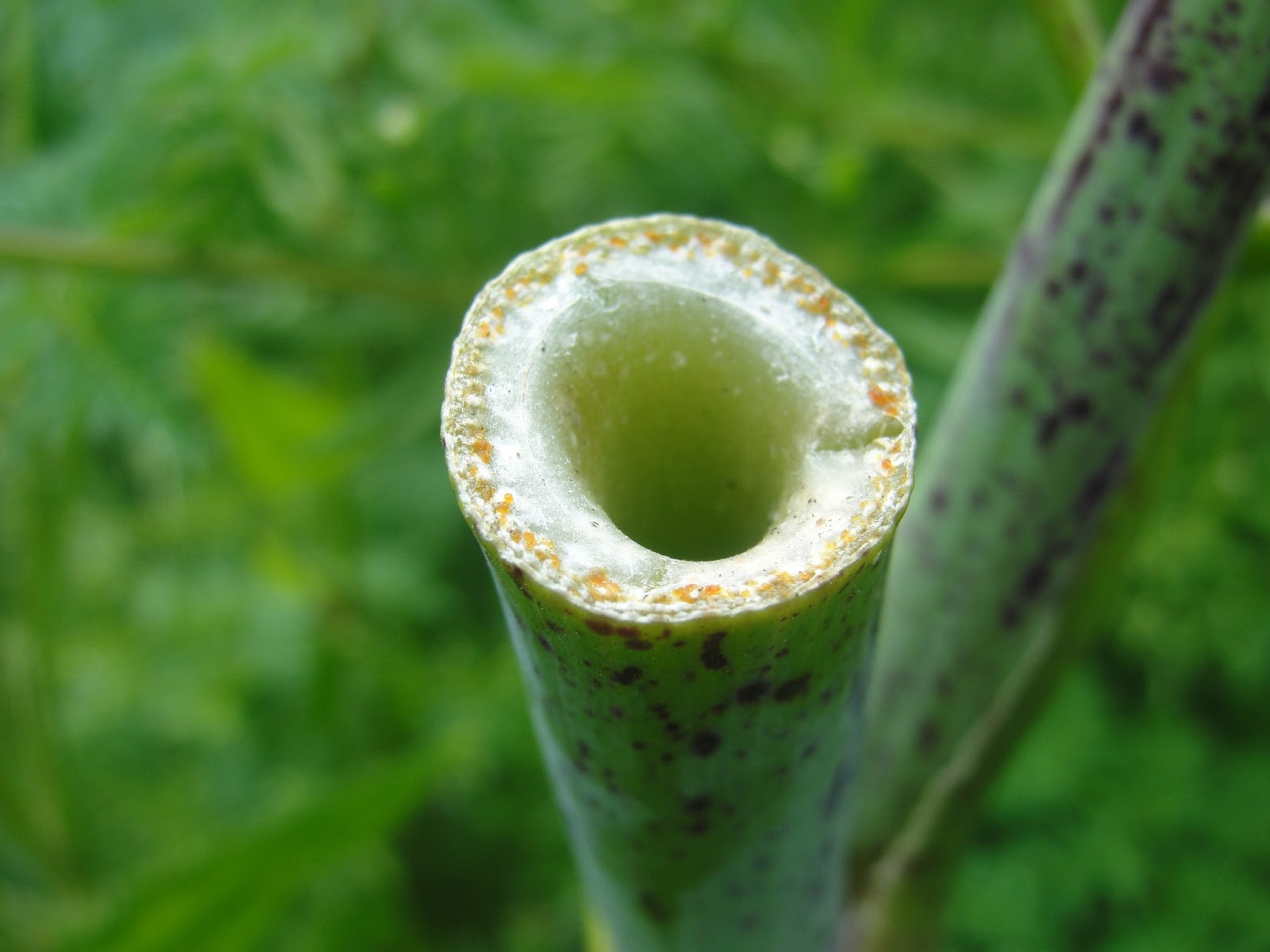
You can see from this shot that the hollow middle is quite a size in relation to the thickness of the wall. Cow Parsley has a smaller diameter hole.


The stalks do have a familiar purple blotchiness (as opposed to a uniform area of colour) but equally, the above right picture does actually show little in the way of purple markings.

They can grow to some size, this stem id about one inch in diameter.

And talking of size...This is a shot of the edge of a 'forest' of Hemlock near were I live. The Hawthorns, grass and fence posts in the foreground give you an idea of the size these beasts can reach, not as tall as Giant Hogweed but more on that leviathan later.


The two leaf shots here give a good idea of the lacy pattern, especially when compared to cow parsley. The other identifier is the mouse cage smell that is associated with this plant.
Hogweed


Whilst I would never risk consuming anything from this family without 100% clarity, I'm 99.9% sure that I've got this plant 99.9% nailed down.
There can be some variation in the leaf shape but it's essentially similar throughout and more importantly, vastly different to Hemlock's lacy leaf.

The flower buds borne in paper like parcels before unfurling

The flowers are quite distinctive, the individual clusters, to me at least, look pom-pom like and the petals are notched.
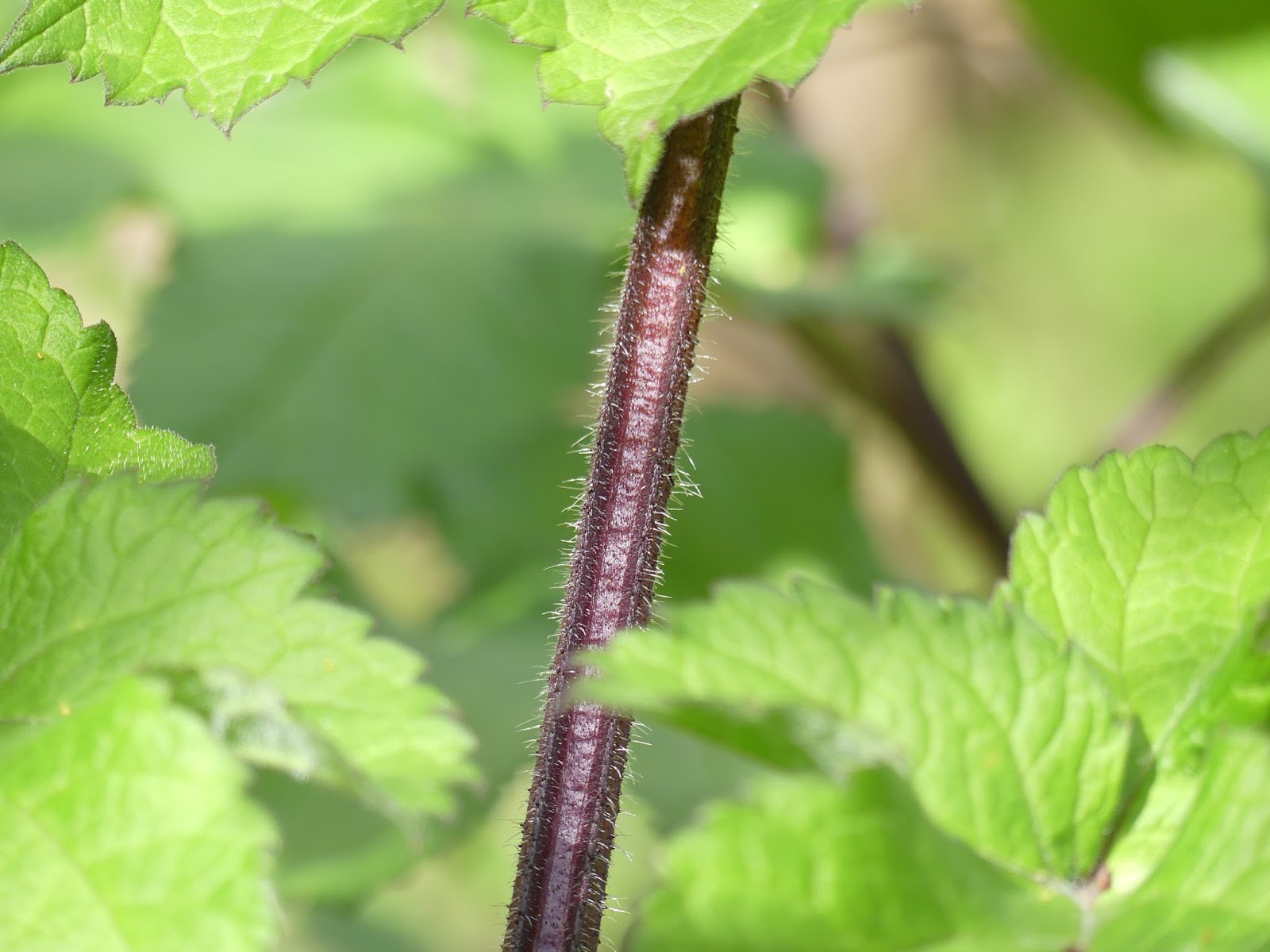

The hairy stalks are rather grooved too, again with some purple like colouration but not blotchy.
Hemlock Water Dropwort

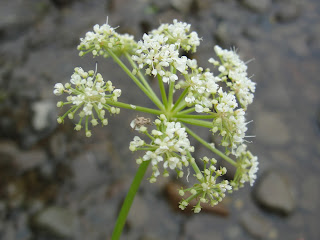
And so to the second plant in John's Facebook question. This is another plant that I don't knowingly have near me (again, these are from Galloway in Scotland). These are also pom pom like but very spread out. There are supposed to be some similar plants to this in looks but the only plant associated with water that I'm happy with is Watercress...anything else is a no no.

Giant hogweed

Finally, whilst they aren't everyone's cup of tea, there is a large patch of waste ground near me that always produces an impressive patch of the much maligned giant Hogweed which occasionally makes the news when an animal or human gets blistered by the powerful combination of sap and sunlight.


The advantage of the Hogweed growing where it does near me is that it is next to a train bridge and as a result it means it is possible to look down on these leviathans instead of straining to look up.


The size is impressive but the flowers and leaves are equally so and quite distinctive.


This fox disappeared into the Giant Hogweed plants shortly after I snapped this picture, I hope he hasn't brushed any broken stems!
Pignut

Often found on forest floors and field margins this diminutive little plant hides a fantastic tuber away. The leaves are like Dill and Nigella and only just protrude a little way out of the ground in the Spring.

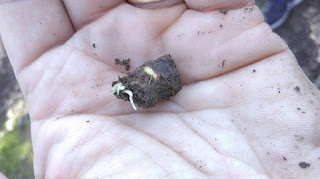
This is the little tuber that is edible. As it grows with other plants it is important to lift it with the above ground parts and stem still attached for positive ID

The outer skin is easliy removed a combination of rubbing and nail action and the size of plant above ground has no correlation to the tuber size below ground. Taste wise I've seen it described in several ways but I always think of a fresh Cobnut.

As Summer approaches the plant flowers and again it has a small but perfectly formed flower that is atop a stem only a few inches high.
Ground Elder


A nightmare for gardeners due to it's tenacity it has a leaf structure and flower reminiscent of Elder. It is low growing and the leaflet nearest the plant usually has a curious double structure in that it forms a near 90 degree angle.
Now in review I think/ know I've got the ID correct for Alexanders, Angelica, Pignuts, Ground elder and Wild Carrots but I at the time of typing I still have reseravtions about harvesting stuff I haven't had before, especially the early Spring growth. I think I'm 100% sure on hemlock to know that from another umbellifer (mainly Cow Parsley). As a footnote, this Hemlock v Cow Parsley video is excellent and this is a good carrot test Facebook photo album.
Any comments welcome, especially on any errors in my assumptions.


