Wednesday, 29 April 2015

Lacto Fermentation

Lacto-fermentation doesn't have a snappy ring does it? It would take a hot PR company to make it so too. Now one of the proudest moments for me in recent years has been the fight a small but organised group of residents took the fight to a waste company to prevent an incinerator being built near our town. Now the reason I mention this is that we all became familiar with waste disposal methods, one of which was anaerobic digestion and the reason that I mention this is that the fermentation process is anaerobic too.


Once I'd got past that thought I set about getting started. In the past I've made some bushcraft confectionery using a Fergus Drennan recipe from a cardboard insert that Bushcraft and Survival Skills magazine (issue 36) had in. I'd always wanted to try lacto fermentation (think Sauerkraut) which also featured on the card. 

Fergus used seaweed in his recipe but an abundant supply of Few Flowered Leek (so called because it has fewer flowers than you might expect for a vigorous grower) near me meant that I was spurred into action to try it. I'd recently had cortisone injections in my hands so I used this as an excuse to send my two sons out to pick them. 


I was planning to make one jar full but the boys applied themselves and came back with a good supply so I thought I'd see if I had enough for a second jar. The leaf cross section in the right hand side picture above triangularish leaf profile.


Onto the milk separation. The recipe used lemon juice and I was interested to see how quickly it separated the curds and whey because I recall helping on a school trip on a Tudor day and vinegar was used to make a cottage cheese whey and it worked quickly (milk protein was also used as a glue for making shields I believe). lemon juice also started off quickly too and was left overnight. I used just under a pint and a quarter for this.


To separate the curds from the whey I used a frame mounted muslin bag which I usually employ to strain fruit when making jam or leather. It looks a bit milky but this is just a small layer of fine whey that gets through which quickly goes to the bottom.


As you can see, the whey is a lot clearer even straight after straining and it made just under a pint from a pint and a half or so. With a fair bit of whey left I added a shot of fine sea salt, lined a pastry cutter with cling film and placed it in the fridge on kitchen roll with a cling film wrapped can on top to shape it and remove the moisture (I had to change the kitchen roll several times).


Whilst letting the whey finish settling I roughly chopped up the Few Flowered Leek and added sea salt and slightly more than the stated amount of whey, and then had fun shoving it all in the jar!


I did have a fair bit left over so I added another Fergus recipe card ingredient, namely grated cucumber to a second jar. This meant the only omitted ingredient was onion as it seemed overkill with obvious properties of the primary ingredient. The only issue I had in the bottling was submerging the three cornered leek leaves whilst leaving a gap. I pushed them down as best I could and wedged a piece of scrunched up cling film in to help submerge the leaves. they are left at an ambient temperature with a regular check for gas build up.


And yep, I still had some spare! I rinsed the whey off the leaves and made a small impromptu pot of pickled leek and cucumber by just adding malt vinegar. To do two small coffee jars full I'd suggest using one and a half pints of milk because it was a bit tight filling the jars with the whey from one and a quarter pints.


For future lacto-fermentation attempts I will leave the leaves either unchopped or only in half (depending what I was doing) because even this very rough chop has seen issues with bits of leaf floating past any plastic bag barrier I insert and the process needs to have oxygen excluded to work. I will also use the jam jar style (pictured above) because I managed to insert a small round plastic disc, cut from a strawberry punnet, into each of the coffee jars and then reinserted the folded bag, but it was a bit of a faff. This shape of jam jar would facilitate a round plastic disc being slipped in easily.


The day after the preparation and bottling I tried the now fairly solid cheese curd with some jack-by-the-hedge leaves on some slightly posh oat crackers and home made slow rise bread. The lemony, salty combination was fantastic with the hastily foraged leaves, and this has led me to purchase some essence of rennet to further experiment with basic cheese making...A happy discovery in the lacto-fermentation process.

I decided to make the switch to the jam jars as I was having continual trouble securing the leaves below the...er...whey line, even with a plastic disc weighed down with a cleaned pebble placed on top! I have popped the disc and pebble in the new jars to and will investigate using clear plastic yogurt lids going forward as they are perfectly round and should fit nicely to the sloping glass sides. As per the procedure I got a gentle 'Phsst' from the mix after five days when I undid the lid to check for gas.


So to the taste. As mentioned earlier I've never tried anything lacto-fermented so I really didn't know what to expect...I like it! The only thing I can liken it to is pickles and specifically cornichons yet it has a taste of it's own.


I have a lot of wild cabbage growing near me, well I'm not 100% sure what it's name is but Kevan Palmer identified it at this evening. Silly boy, I should have concentrated. Anyway, I was going to try and make Sauerkraut but the cabbage plants aren't big enough at the moment so it will wait...Like the impromptu pickled Few Flowered Leeks that I did...All good things and all that. Oh, and the Few Flowered Leeks were decent too.


Saturday, 25 April 2015

Ragsto Kelly Kettle Bag

A while ago I stripped a load of leather off my old three piece suite and harvested lots of usable stuff, and whilst I have several projects in mind, including another crack at these Joe O'Leary inspired moccasins I had more than I could use.


A Scouting magazine supplement  article featuring Ragsto

I mentioned at the end of the stripped leather blog page that I'd be sending a large quantity of leather to Ragsto, and getting a Kelly kettle bag made at the same time. I have to confess that I forgot it was all boxed up and have only just dispatched around four and half kilos of leather via the  folk at Parcelforce. I'd said that I'd do a blog about the bag when it arrived and requested some pictures of the before and after so there aren't any of my own on here.


My original kettle bag is really showing it's age so it needed replacing, and I've also got a piece of my sofa back! The Ragsto site has a bushcraft section.

Saturday, 11 April 2015

Three Leaves, Three Ways

Three leaves, three ways...with different dishes, different results.


Having seen Kevan Palmer’s quiches from his rather fine blogging efforts from last year  I decided that I’d have a crack to hopefully sneak some foraged ingredients into tea, under the family’s radar(!). The three leaves used are: Few Leafed Leek (with a chivey, leek taste), Jack-by-the-Hedge (a chivey taste), and Ramsons (a garlicky taste).


few leaved leeks and ramsons growing together

 By the way, I love the way that leaves can vary in size and shape, none more so that the jack-by-the-hedge. As you can see in the picture below it can be as small as a 10p, or the size of a jam lid, rounded or arrow head shaped. But I digress.


I decided to do a ham hock*** and few leaved leek, ramson and jack-by-the-hedge creation with the ratio of leaves being in the ordered stated about 5:3:2 (I guessed the leek taste would be at home in a ‘normal’ quiche). 


Whilst in the groove I decided to make a ransom flat bread. I'm not really a fan of it's taste when used in pesto but thought a flat bread might work. I judged the flour by eye (plain and self-raising to roughly a 3:1 ratio) and rolled  a good handful of coarsely chopped ramson leaves, a little jack-by-the-hedge and a small addition of coarse sea salt crystals. It was cooked in a medium oven for about ten minutes and grilled for two minutes or so to add a little colour to its cheeks.
This amount of ramsons  gave it a mild taste and it could easily be ramped up for a stronger tasting bread. The coarse salt adds a nice ping too.


To make the trio I decided to experiment making a vichyssoise (essentially a posh leek and potato soup) using just few leaved leek. I added about ten roughly chopped large leaves (about one ounce) to potato and stock, and then blitzed. 

So onto the family taste tests. It was wins with the  on the first two, but a tad disappointed with the last one. I cooked the leaves for a short while just to try and make sure the leaky taste stayed, but it wasn't to be. It still tasted OK as a summer greens type of soup, but wasn't quite the real deal...maybe extra leaves with ramsons next time...I have seen a soup recipe using similar three cornered leeks on the rather brilliant Eatweeds website but whilst garlic is listed in the ingredients, I can't see that the leeks are. 


Sunday, 29 March 2015

Horseradish Root

You may or may not know that horseradish grows in large clumps in the UK countryside, I haven't got access to it so I took route B and purchased one from a supermarket (as it's seasonal this link may or not work if viewed some time after this blog page is published. 


It looks a little like an elongated celeriac and that's where the similarity ends between the two. I wanted to make some horseradish sauce and in the process get the family to sniff the grated root, cad and bounder that I am.


Predictably it needs peeling first and this is done with ease, it's about as easy as a potato.


The peeling is the easy bit, the grating is a bit more demanding. By demanding I mean fume wise because it's not much different to grating a parsnip effort wise. It starts off ok at the thin and but builds to an intensity that will leave anyone in the room bemoaning the acrid whiff! You'll notice that there is a sort of fibrous bit that will either need discarding or more work.


Here is a shot of the return you get from a root, and you can see the large usable pile and the smaller fibrous material side by side. You simply can't peel it without having a close up smell of it. It really takes the unwary back and you can feel it through your nasal passage like a large intake of English mustard.


I made the sauce as per the supplied instructions (variation son this theme work too) and decided to try dehydrating the rest. Once done I put it in a mortar and pestle to grind into a powder, and used a little course sea salt to grind the last tougher fibres up. 


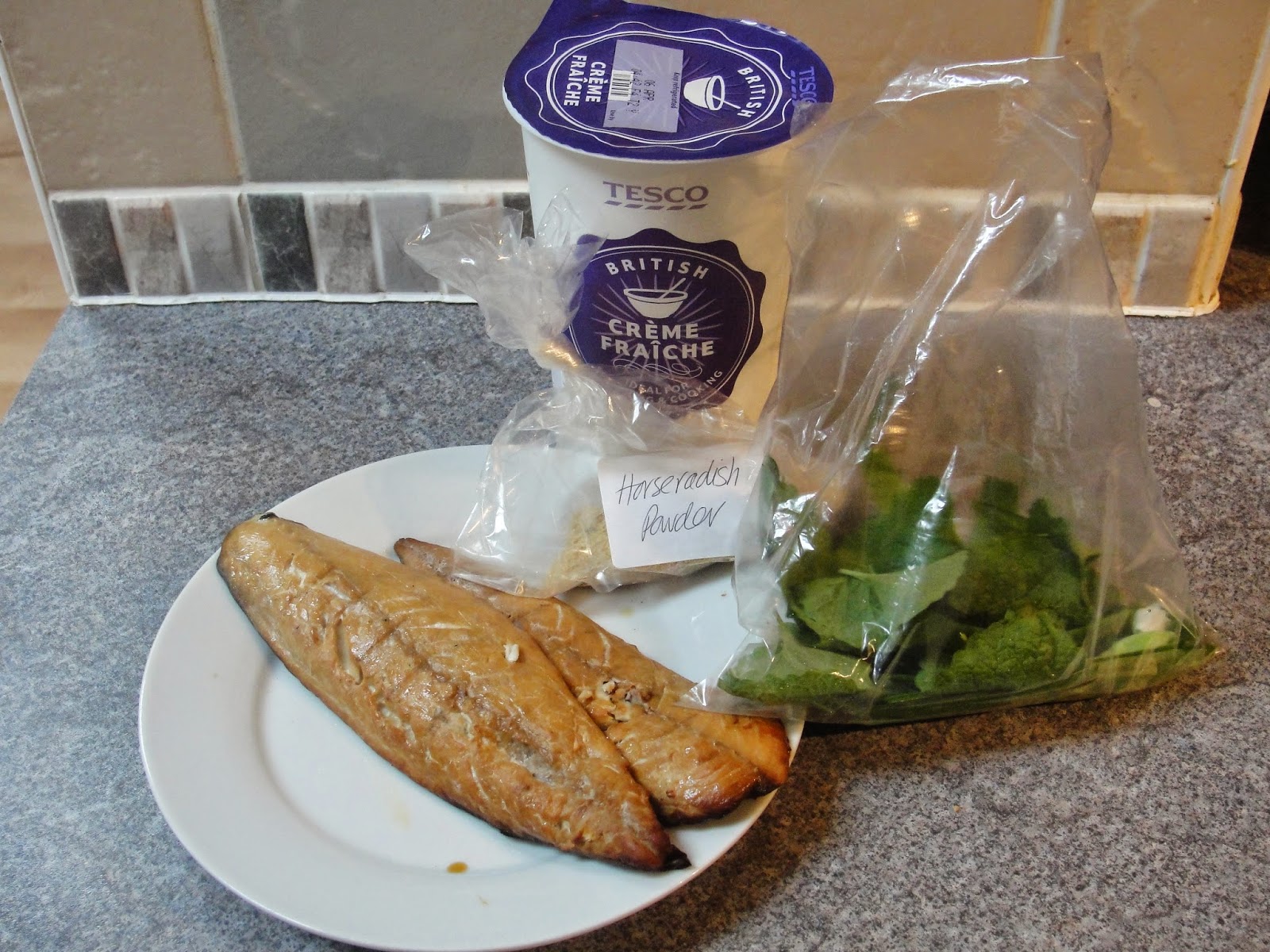
This is the sauce (which surprisingly mellows somewhat with cremé  fraiche etc added. I had recently had mackerel paté at a restaurant that had a shot of horseradish in and it really cut through the oiliness of the fish so I thought I'd try and produce my version of it.


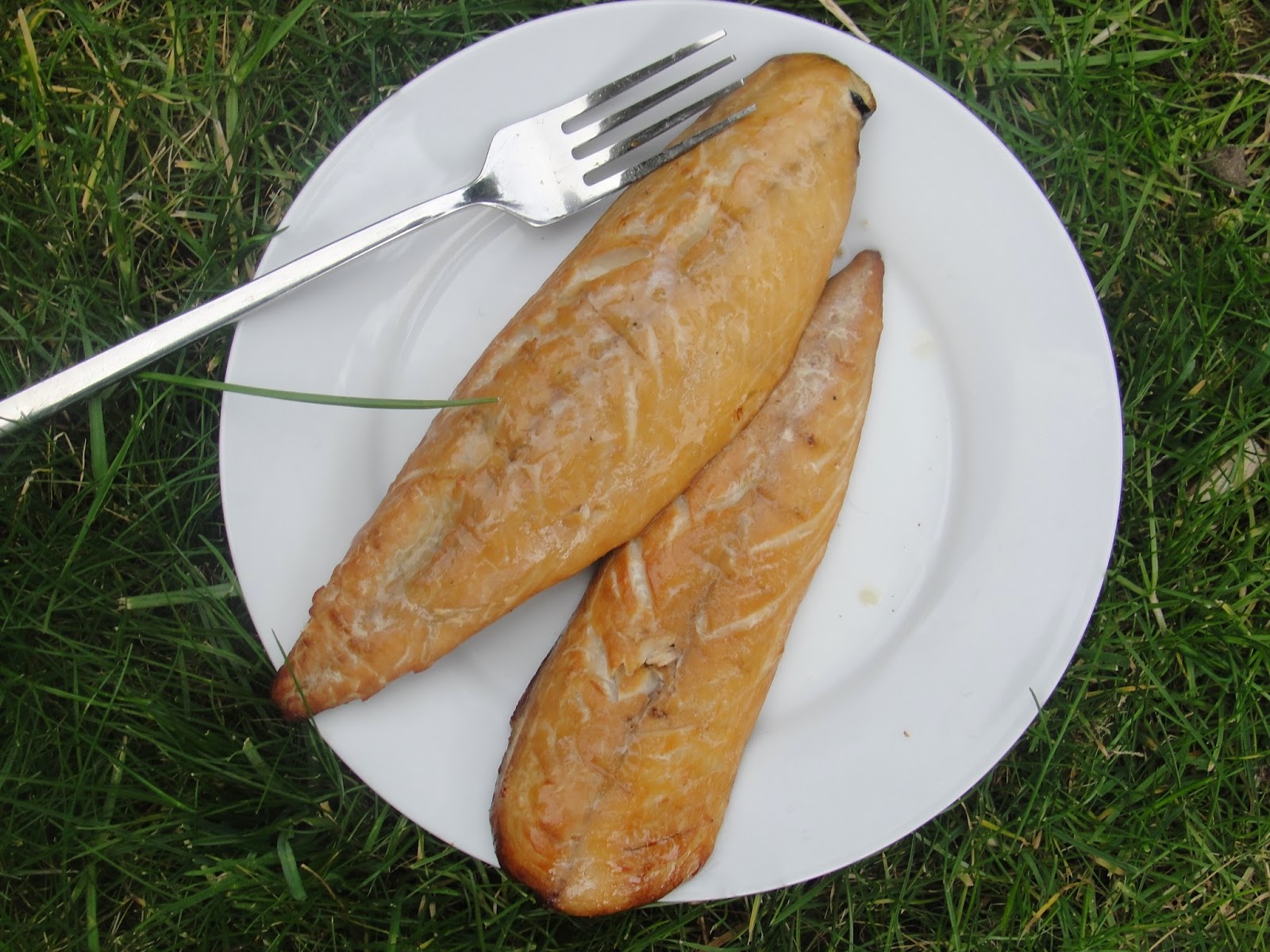
First off two shop purchased mackerel fillets into the smoker with some Jerky Shack oak chips which give a nice rounded smokiness. 


Once done it they were then skinned and de-boned (and the dark ventral meat removed) and it was then time to gather the two ingredients that I was going to use as garlic and onion substitutes. The first was jack-by-the-hedge. I love how the leaves can be either rounded or pointed lobes... 


The other foraged ingredient was three cornered leek-Well I think it is-I had a prominent bushcraft instructor ID it but I can't recall whether it was this or not, but I know it's edible. I've included the flower (which are multiples from one stalk when fully out) and a cross section of the stems which don't exactly look three cornered if I'm honest.  


Once the greenery was chopped I added the other ingredients which were the powdered horseradish and  creme fraiché to the blitzer and pulsed it all to a well, a paté.


The finished result has a slightly more green hue to it with the verdant allium substitutions as compered to regular mackerel paté and I got my family to try and it was liked because the smokiness wasn't too ballsy. The only thing was, the horseradish powder had lost a lot of it's potency having been prepped and ground which was disappointing but you never know until you try these things. 


Saturday, 28 March 2015

Outdoor Adventure Manual anniversary


Upon a morning visit to Facebook I was greeted with a 'flashback' that the site provided me reminding me of the fact that I'd posted about the imminent release of a publication called The Outdoor Adventure Manual 2 years ago (4th April 2013 to be precise).

Whilst not a bushcraft publication in its entirety I was lucky enough to be asked to help write stuff for this publication which was a joint collaboration between the Scout Association and Haynes publishing (famous for the car manuals). I’ve written articles for Scouting magazine and the Cub supplement (whilst it lasted for)  for around 18 months/ 2 years (it started by accident) and whilst on a visit to Gilwell HQ to see one of the magazine editors I was approached by The Scout Association's Creative and Brand Advisor Chris James, had a meeting with him and I was on board with several other scouters!
Chris asked me if I could recommend any other potential writers, I said ‘What about if I could get some professional outdoor instructors on board to write?’, Chris meant scouters but left it with me. A little bit of networking later, including email, face to face, the Bushcraft Show and Facebook (a positive use of a much maligned media) and the following were on board:
Pablo (www.woodlife.co.uk )-Tracking
Paul Kirtley (www.frontierbushcraft.com)  – Knife sharpening and usage
Joe O’Leary (www.wilderness-survival.co.uk) – Water
Tristan Gooley (www.naturalnavigator.com ) Natural navigation
Dale Collett (www.learnbushcraft.co.uk )- Bowdrill
Kevan Palmer/ Jason Ingamells (www.woodland-ways.co.uk) Dutch oven usage
Fraser Christian (www.coastalsurvival.com) –Countryside  and coastal foraging
Scouter Terry Longhurst also asked Jon Mac spooncarver, kuksa maker and all round woodworking clever chap (http://spooncarvingfirststeps.blogspot.co.uk/ ) if he would do a ‘How to’ on spoon carving too. The Scout Association also asked the Red Cross to do a big piece on first aid. I also did the draft illustrations for Tristan's and Joe's articles and started a Facebook page for the publication that is still getting likes today..


It started out with Haynes wanting articles into Chris in a very short window, and then once it was all gathered there was a large period of relative inactivity until Haynes suddenly asked that all the articles were proof read. I volunteered and on one occasion I sent an email back having checked one lot as another email load came in! This short editing window did mean that there were some recommendations made that couldn't be acted upon due to the timeline.

 Despite some faults I felt that a book knocked up with all contributors in relative isolation didn't come out too badly and it  had several positive plaudits at the time. I’ve already thanked the guest contributors but I feel obliged to thank them again…every one of them to a man readily agreed to contribute to this project and it’s very satisfying to know that they all feel comfortable aligning their name to the Scouting brand.


I managed to get an article in the John Lewis internal weekly magazine and my local paper (with a potential audience of 100,000+). I've also included a basic shot of the two articles that I've mentioned. 

And here's a picture that Jon Mac posted on his Facebook page and I just had to share it. He was so pleased to be included in the above book that he asked his postie to pose for a picture with it! How refreshing. Have a look at his blog http://spooncarvingfirststeps.blogspot.co.uk/ . Bushcraft & Survival Skills also reviewed the book in a past issue too, once in the in the news section and also in the book review section and I thought the review was very fair.

I think this book has pushed the outdoor agenda more than any other Scouting publication and to my mind the next step is a book called 'Scoutcraft' in which the outdoors focus is skills and (bush)crafts that B-P would recognise. 

I'm also pleased to say that it is the very  first book in the Scoutmastercg website list of Great Books For Scouters and said the following:-

 'Published by Scouts UK with a forward by Bear Grylls The Outdoor Adventure Manual is packed with practical Scout skill tutorials; tents and camping, fire, food and cooking, tools and gadgets, knots and lashings, navigation, first aid and survival and more. Skills are explained step-by-step with photos and illustrations that really bring them to life. I’ve read a number of ‘how-to’ books that I suspected were written by people who had not actually tried out what they were describing. The Outdoor Adventure Manual leverages the know-how of many experienced authors to provide practical instruction that is inspiring and easy to follow'.

And whilst on the subject of Scouting, if you are a bushcrafter, why not volunteer with your local group with the occasional outdoor activity? A lot of groups have loads of kit, a place to have fires (do you?) and a willing audience, even simple stuff like charcloth leaves them spellbound.